In 2022, the Indian National Congress elected Mallikarjun Kharge as its national president — a move heralded as a watershed moment. The party highlighted his Dalit background and non-Gandhi lineage as symbols of inclusion and internal democracy. However, two years on, the Kharge presidency has revealed itself to be less of a genuine leadership shift and more of a strategic manoeuvre — one deeply rooted in caste optics, designed to preserve the Gandhi family’s influence while projecting a superficial image of reform.
At the heart of Congress’s current malaise lies a dual leadership problem: a nominal president with limited authority and a de facto leader in Rahul Gandhi who continues to exercise control without accountability.
A Symbol Over a Strategist
Mr Kharge’s ascent was viewed by many as the Congress’s attempt to reconnect with the Dalit electorate and portray a progressive, inclusive image (The Wire). But his presidency has been anything but transformative (The Print).
Despite his long parliamentary career, Mr Kharge lacks pan-India visibility, mass appeal, or a track record of leading electoral turnarounds (India Today). The Congress under his leadership has lost six out of nine major state elections, struggled to maintain alliances, and failed to arrest the decline of its vote share, which slipped below 18% in the 2024 general election (Hindustan Times).
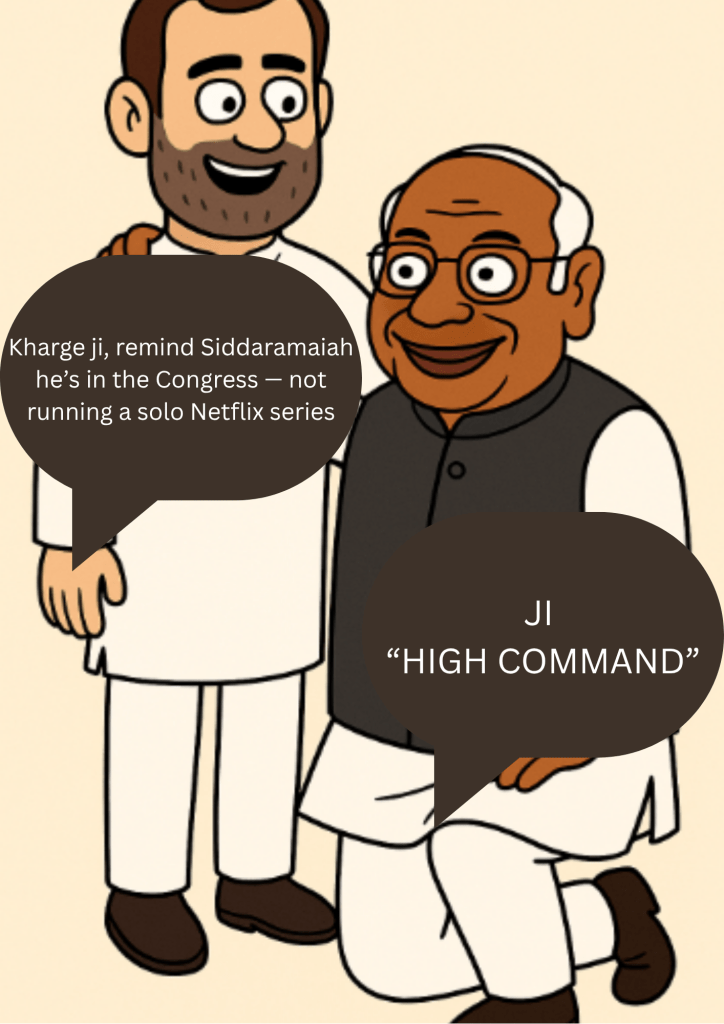
His public references to the “high command” only reinforce the reality that the real power continues to reside with Rahul Gandhi, whose informal and unaccountable leadership continues to overshadow the institutional one (Indian Express).
Rahul Gandhi: The Reluctant Commander
While Mr Kharge may be president in name, it is Mr Rahul Gandhi who continues to shape the party’s narrative, strategy, and campaign (The Hindu). But his leadership style remains ad hoc and elusive (India Today).
Mr Gandhi resigned after the 2019 defeat, only to return in an unofficial capacity — leading yatras, issuing statements, and handpicking candidates — all without formally reclaiming the top post (BBC). He has refused to stake a claim as the prime ministerial face of the opposition, often disappearing during moments of strategic urgency, and has allowed uncertainty to define the Congress’s direction (The Print).
Critics, including those within the Congress, have increasingly described him as “unavailable in crisis, unwilling to lead, yet unwilling to let go” (Economic Times). The outcome has been confusion on the ground and loss of credibility among regional allies and voters alike (Indian Express).
Tokenism Without Reform
Congress’s elevation of Mr Kharge was intended to signal a commitment to Dalit empowerment (The Wire). But in practice, it has done little more than offer a symbolic gesture (The Print). There has been no meaningful structural empowerment of Dalit leaders within the party, nor any policy narrative crafted around their concerns (The Print). Unlike the BJP, which has strategically built its outreach through appointments like Droupadi Murmu and Ram Nath Kovind, the Congress’s caste approach appears performative (Indian Express).
Moreover, internal reform — be it in candidate selection, youth inclusion, or ideological clarity — has been painfully slow or entirely absent (Hindustan Times). Prominent younger leaders such as Ghulam Nabi Azad, Sachin Pilot, Shashi Tharoor, and Milind Deora have remained sidelined (The Hindu), while organisational inertia has deepened (Times of India).
The Consequence of Inertia
This leadership vacuum has had serious implications beyond just the Congress’s internal health (The Print). As the anchor party of the I.N.D.I.A. alliance, the Congress failed to lead with clarity (Hindustan Times). Seat-sharing talks were marred by inconsistencies, communication breakdowns, and ego clashes (Indian Express). Mr. Kharge’s inability to assert authority, coupled with Mr. Gandhi’s reluctance to lead from the front, cost the alliance momentum during crucial months leading up to the 2024 elections (India Today).
The result? A fractured opposition, an emboldened BJP, and a dispirited Congress base still searching for direction (NDTV).
The Road Ahead
For a party that has ruled India for over half a century, Congress today finds itself at a crossroads — caught between symbolic politics and substantive reform, between dynastic deference and democratic urgency (ORF).
If the party wishes to remain relevant in the rapidly evolving political landscape of India, it must do more than install figureheads and organise yatras (Indian Express). It must:
- Democratise decision-making (The Hindu),
- Empower state units and grassroots voices (Scroll),
- Hold its informal leadership accountable (Deccan Herald), and
- Prioritise performance over pedigree (Business Standard).
Until then, the Congress’s leadership structure — with a ceremonial head and a reluctant commander — will remain its greatest liability, not its strength (India Today).
 SattaWatch
Leave a comment